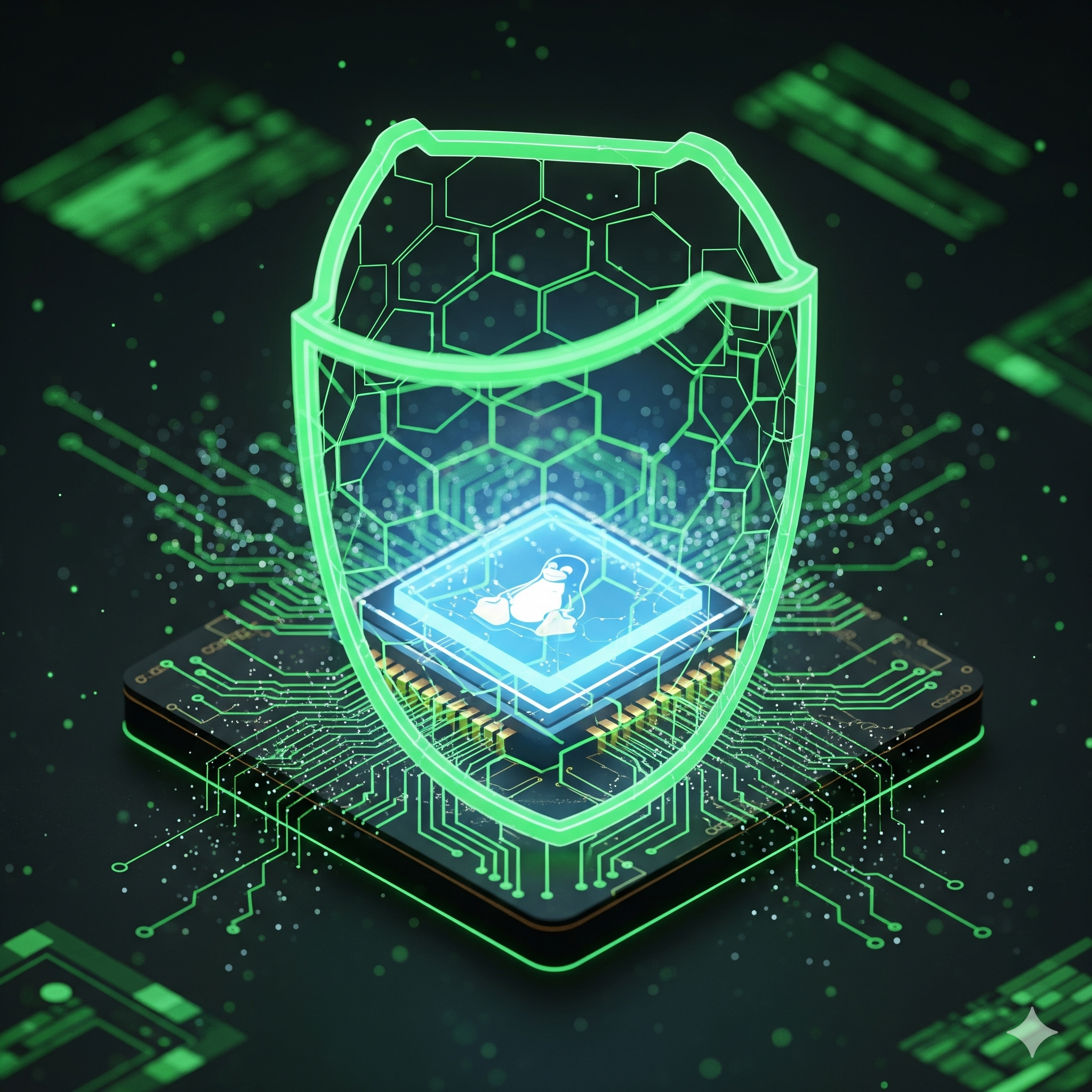
IronClad Kernel Guardian Founder's License
unlimited use
$14.99$9.99
Stop Exploits Before They Execute.
The first eBPF-powered Active Defense System for Linux. Quarantine vulnerable processes at the kernel level.
The "Patch Gap" is Your Biggest Risk
Every day, a new CVE is disclosed.
Traditional Antivirus is too slow. It scans files after they land on disk.
EDR is too heavy. It burns CPU cycling between user and kernel space.
Patching takes time. You can't reboot your production database in the middle of the day.
You need a shield that works now.
Enter IronClad Guardian
IronClad isn't just another scanner. It's a Kernel Guardian. By leveraging eBPF (Extended Berkeley Packet Filter), IronClad injects a high-performance security layer directly into the Linux kernel.
It watches every system call, every execution attempt, and every network packet with nanosecond precision
Key Features:
Active Quarantine
Don't just detect—deny. IronClad uses Linux Security Modules (LSM) to intercept execve calls. If a vulnerable process tries to spawn a reverse shell, the kernel says "No."
Zero-Downtime "Virtual Patching"
Can't upgrade that critical legacy app yet? IronClad wraps it in a protective eBPF bubble, neutralizing known exploit vectors instantly without a restart.
Real-Time Telemetry
See what's happening right now. Our terminal dashboard gives you a live feed of blocked attacks, CPU usage, and active network connections.
Automated Intelligence
IronClad syncs with the Exploit-DB daily. It knows about the vulnerability in your web server before you do—and it knows exactly how to stop it.
How It Works (The Tech)
Scan: IronClad audits your system packages against 45,000+ known exploits.
Target: It identifies the PIDs of vulnerable running services.
Inject: It loads a safe, verified BPF program into the kernel.
Enforce: When a threat actor triggers an exploit, the BPF probe intercepts the execution flow and drops the malicious request.
Comparison: IronClad vs. The World
How does Kernel-Level security stack up against traditional tools?
Feature | Legacy Antivirus | Network Firewall (WAF) | Traditional EDR | IronClad |
|---|---|---|---|---|
Primary Scope | Files on Disk | Incoming HTTP Traffic | User Behavior | Kernel Execution |
Mitigation Logic | Delete File | Drop Packet | Kill Process | Block System Call |
Virtual Patching | No | Limited (Web Only) | No | Yes (Any Binary) |
Performance Impact | High | Added Latency | Medium | Near-Zero (<1%) |
Reaction Time | Post-Infection | Pre-Ingress | During Attack | Pre-Execution |
Can be Bypassed? | Yes (Fileless Malware) | Yes (Encryption/VPN) | Yes (User-Space Hooks) | No (Ring 0) |
Why IronClad Wins
vs. Antivirus: AV catches malware after it's written to disk. IronClad stops the vulnerability that allowed the malware to enter in the first place.
vs. WAFs: A WAF protects your web port (80/443). IronClad protects the application itself, defending against internal threats, privilege escalation, and non-web vectors.
vs. EDR: EDR tools are powerful but complex and heavy. IronClad is lightweight, surgical, and purpose-built for server stability.
Ready to Lock Down Your Infrastructure?
Join the active defense revolution. Take back control of your kernel.
[Download IronClad v2.0 for Linux (AMD64/ARM64)]
Open Source. Native Go + C. Built for the Modern Cloud.
.